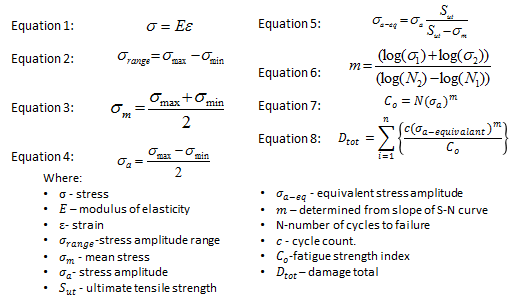
1. Obtain a real time signal from a strain gage mounted at a critical location. 2. Convert real time
strain to real time stress simply by multiplying by the modulus of elasticity
(Equation 1).
3. Data is
filtered to eliminate
redundant data points and
record peak and valleys.
4. The data will go
through the rainflow counting method (Figure 1) which will determine the cycle count, the stress
amplitude range (Equation 2), and mean stress (Equation 3) for each stress cycle.
5. Use the modified
Goodman Approach by utilizing the
obtained stress amplitude (Equation 4) and mean stress to convert to a
completely reversed equivalent stress amplitude for each stress cycle (Equation
5).
6. Before you can
use the damage equation you must obtain the values for m (Equation 6)
and C_o (Equation 7). 7. Finally using the
damage equation you can predict the damage per cycle and add them cumulatively
(Equation 8). | 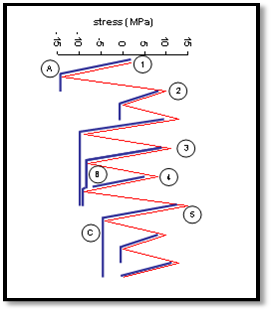 |